By Nicole Hamouche — September 2025
INTRODUCTION
When we enter Afaf Zurayk's atelier and apartment in Hamra, which once was the vibrant heart of Beirut, we are immediately enveloped by a certain quality of silence and light, as if entering a sanctuary. We sit surrounded by the strong and nurturing presence of her paintings, in their white and evanescent colors and shapes. They emanate an aura that the artist herself exudes: a powerful sense of softness and embodiment. On the low table of her living room, Origami birds and colored pieces of wood from her series Driftwood contribute to this impression of softness and aliveness, an antidote to the tumultuous Lebanese environment outside. It is amidst this combination of turmoil, tenderness, and respite that Afaf Zurayk has produced most of her work, for which she was honored with the Juhayna Baddoura Award in 2017, a tribute to artists whose work has received less visibility than it deserves.
When accepting the prize, the artist spoke about her "passionate engagement" with visual art. She said: "It is the place where I express my fervor and my emotions. It is the refuge that I have found for myself when the war erupted in Lebanon and turned our lives upside down. To escape terror and violence, I have started painting with even more fervor and poetry. And since 1978, I have entirely dedicated myself to art."
Zurayk's work and the artist's life is a testament to resilience and the power of art in the face of adversity. If Zurayk is not a traditionally engaged artist, she is no doubt a committed one, shaped by the upheavals and history of the Arab world. Even though her message is never direct – and this is perhaps its interest – her art is a resistance to the culture of silencing and of violence, a reminder of our shared humanity, in which she always found solace.
BECOMING AN ARTIST
Afaf Zurayk is one of the last figures of a generation of prominent Lebanese women artists who emerged in the 1960s–70s, when Beirut was an epicenter of art and creativity. Born in 1948, she came in touch with art at an early age, growing up in a highly cultured and modern family who encouraged her talent. When they first oriented Afaf towards painting, her parents viewed it as a means of channeling her energy. She was fortunate to have Helen Khal, a prominent Lebanese American artist, as one of her tutors. Zurayk recalls having been totally enthralled by one of Helen's paintings when she was nine years old, and that this was the moment she decided that she also "wanted to be in this place where [she] can show the transparency," which she eventually did.
Afaf Zurayk was educated at Al Ahliya school, an institution famous for its post-modernist spirit, which very much aligned with the views of her father, the famous intellectual, historian, and academic, Constantine Zurayk, who was one of the pioneers of the Arab nationalist movement. Passionate about painting, Afaf trained in Fine Arts at the American University of Beirut and then studied Islamic arts at Harvard University in the United States. After graduating in 1972, she returned to Lebanon where she practiced her art and taught for a few years at Beirut University College (BUC), now the Lebanese American University.
The violence that followed the outbreak of war in 1975 was a definitive turning point for Zurayk, who said she felt that "the carpet was taken from under [her] feet." Despite this, and perhaps because of it, Zurayk decided in 1976 to focus on her artistic practice. She recalls: "The only thing I could ground myself in was my art."
"RESOUNDING SOUND OF SILENCE": ZURAYK'S ART
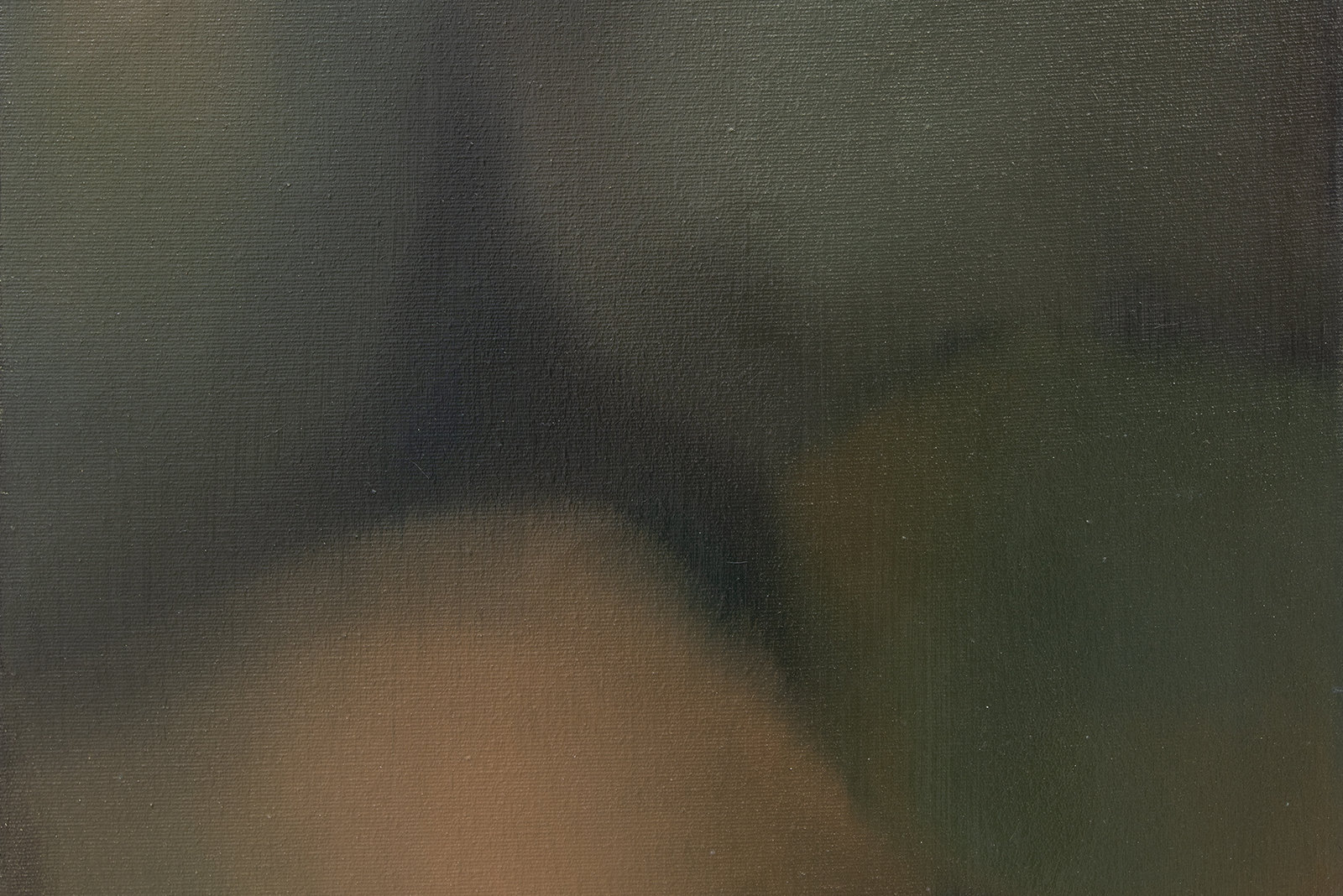
According to Zurayk, her art helped her cope with violence, darkness, and the existential questions that living in a volatile and harsh environment raises. "My art has made me face the question of evil or the combination of beauty and violence," she says. Indeed, even in her dark paintings, there is always a shaft of light.
Zurayk's art is subtle and all about abstraction, and her creativity is, paradoxically for a visual artist, not as much about seeing as it is about listening. According to her, the impulse driving her work is listening to "the resounding sound of silence," which triggers in her an initial gesture that then engenders what she calls a choreography of movement. Sylvia Agemian, Zurayk's friend and curator of the retrospective exhibition Return Journeys, called her "the painter of the intangible."
If her work is more about a texture and a feeling than clearly about content, there are nevertheless a few major recurring themes and subjects: inner exploration, self-questioning, the entanglement of personal and collective journeys, the call of nature and of life in its natural abundance; that of water, of forests, of the sky and their symbolism of continuous regeneration, femininity, and womanhood; the multiplicity of worlds, possibilities, and layers; spirituality and a philosophical quest to address the questions of violence, of suffering, and of forgiveness, including of oneself.
These themes are reflected in the titles of her exhibitions: Light Enters (2025) in Paris together with Amy Todman; Beirut Octet (2023); White (2021); Shifting Lights (2017), in collaboration with photographer Noël Nasr and architect Rami Saab in the iconic museum Beit Beirut; …and morning drew softly (2013), Scripted on water (2012), and A day in the life of a pomegranate (2013), the latter two together with Cornelia Krafft. With this prolific production, the artist, though reserved and low profile, has chosen to focus on light, fluidity, and the ethereal, which has become her signature style.
The full essay continues online and is also available as a PDF download.
Back to Literature
Essay on the Work
On Afaf Zurayk: The Supremacy of Light & Silence
Nicole Hamouche September 2025 Fiker Instituteessay
Unable to render this PDF inline.
Open PDF directly